
The visibility gap: why hotels are losing ancillary revenue guests never discover
The hospitality industry has spent years optimizing room distribution. The next competitive advantage may come from helping guests discover more of what already exists inside the stay.
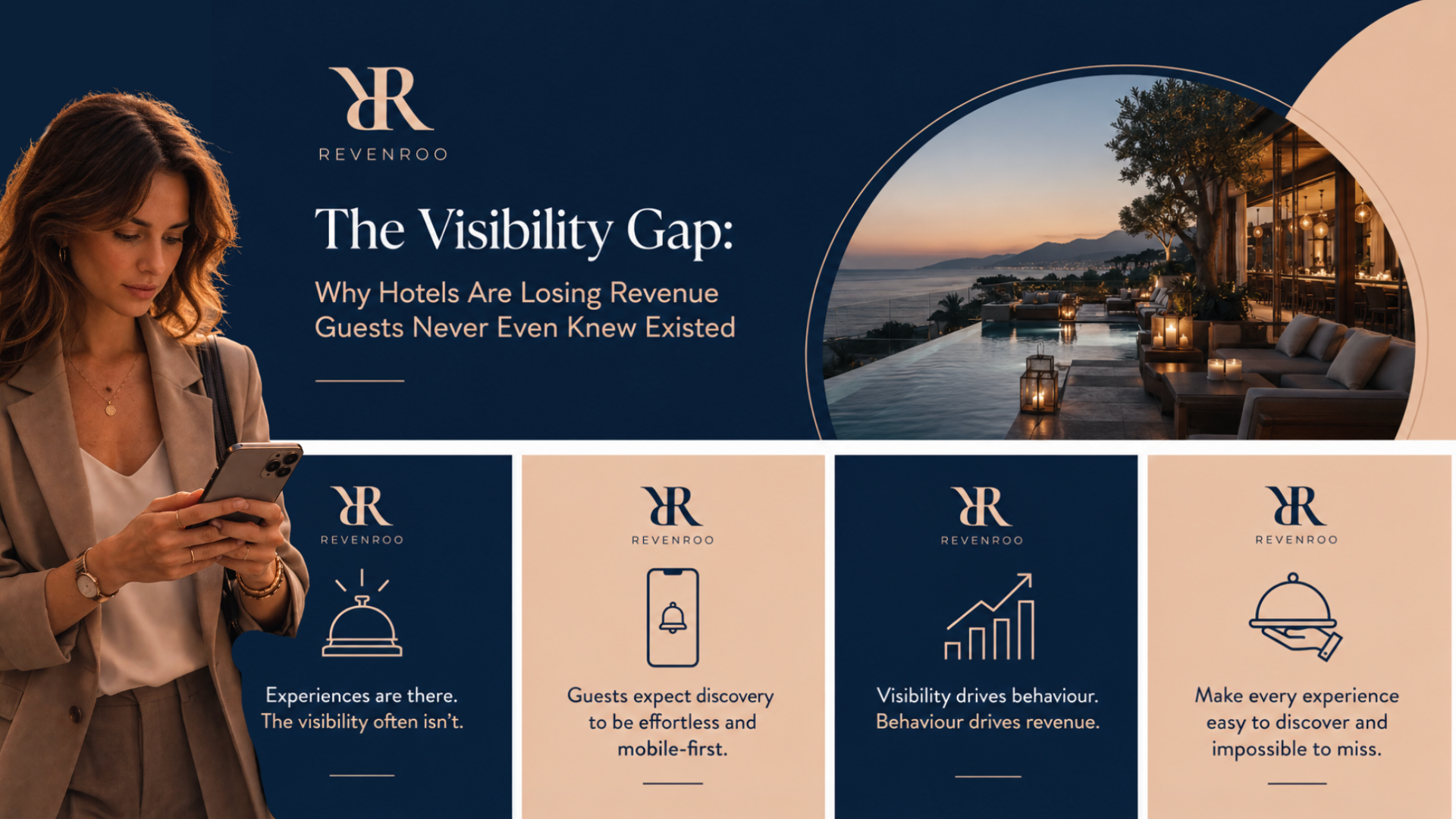
Revenroo
The hospitality industry has become exceptionally good at selling rooms.
Distribution has evolved rapidly over the past decade. Hotels now operate across sophisticated booking ecosystems involving OTAs, metasearch platforms, channel managers, dynamic pricing systems and increasingly AI-driven search environments.
But while hotels have optimized how guests book the stay, many are still under-optimizing what happens after guests arrive.
And that is creating a growing visibility gap inside hospitality itself.
Across hotels, resorts and lifestyle properties, large portions of ancillary inventory remain under-discovered during the guest journey:
spa availability
dining experiences
rooftop venues
wellness offerings
day passes
curated events
upgrades
premium amenities
in-property experiences
Not necessarily because demand is missing.
But because visibility is.
Key takeaways
Modern hotels often have a discoverability problem rather than an inventory problem
Guests increasingly default toward the easiest visible option during a stay, even if better on-property experiences already exist
Traditional hospitality communication systems such as printed compendiums, TV menus and fragmented apps create discovery friction
Mobile-first guest behaviour is reshaping how travelers expect to explore hotels and resorts
Visibility directly impacts ancillary revenue because guests cannot engage with experiences they never discover
The next phase of hospitality technology is shifting toward connected discovery environments rather than disconnected operational systems
The behavioral shift happening inside hospitality
Guest expectations around discovery have changed significantly over the past few years.
Modern travelers now operate in highly mobile, low-friction digital environments where immediacy shapes behaviour. Whether ordering food, booking transport or discovering restaurants, consumers have become accustomed to experiences that are contextual, visual and instantly actionable.
Hospitality has not always evolved at the same pace.
Many hotels still rely on fragmented discovery systems spread across:
paper directories
front desk recommendations
television interfaces
PDFs
separate booking portals
disconnected hotel apps
The result is that guests often leave properties unaware of a large percentage of the experiences available to them.
This creates an important commercial issue because ancillary revenue increasingly plays a significant role in overall hotel performance, particularly across resorts, luxury properties and experience-led hospitality brands.
The challenge is no longer simply creating experiences.
It is surfacing them effectively during the guest journey.
Why discoverability matters commercially
Guest behaviour inside hotels is heavily influenced by visibility and timing.
A guest who sees a rooftop dining experience while relaxing by the pool may book immediately.
A guest who discovers a wellness treatment after searching externally for nearby spas may never engage with the hotel’s own offering.
In many cases, spending decisions happen contextually and in the moment.
This makes discoverability operationally important rather than purely marketing-led.
Hotels have historically focused heavily on pre-arrival conversion and occupancy metrics. But as hospitality becomes more experience-driven, the ability to guide guests toward relevant on-property experiences is becoming increasingly valuable.
This is particularly relevant as hotels continue investing heavily in:
wellness infrastructure
experiential travel
premium food and beverage
destination programming
lifestyle positioning
Without strong visibility, much of that investment risks remaining underutilized.
The luxury hospitality challenge
This visibility gap becomes even more noticeable in luxury hospitality.
Guests increasingly expect the digital layer of a hotel experience to feel as seamless as the physical environment itself.
A beautifully designed hotel paired with fragmented or outdated guest-facing technology creates friction that feels increasingly misaligned with modern luxury expectations.
The shift is less about adding more technology and more about reducing discovery friction.
Increasingly, the most effective hospitality technology operates quietly in the background, helping guests navigate experiences naturally and intuitively throughout the stay.
How AI and conversational discovery are changing guest expectations
The rise of conversational AI is accelerating this behavioural shift further.
Guests are becoming more accustomed to asking for recommendations conversationally rather than navigating static menus or searching manually.
This is already changing broader travel behaviour across:
trip planning
hotel discovery
dining recommendations
itinerary building
experience selection
Inside hospitality, this creates opportunities for hotels to rethink how guests discover and engage with the property itself.
Rather than relying on static information systems, hotels are beginning to move toward more dynamic and conversational discovery environments that help surface experiences contextually throughout the stay.
What hotels are getting wrong about guest discovery
One of the most common misconceptions in hospitality technology is assuming guests will actively search for experiences themselves.
In reality, most guests repeat what feels easiest and most visible.
If discovery requires too many steps, guests disengage quickly.
This is particularly important in resort and lifestyle hospitality where the value of the property extends far beyond the room itself.
The challenge is not necessarily creating more experiences.
It is making existing experiences easier to see, explore and act on.
How RevenRoo helps hotels reduce the visibility gap
This is the challenge RevenRoo is designed to solve.
RevenRoo creates a connected guest experience layer that helps hotels surface their experiences more effectively throughout the guest journey.
Rather than relying on fragmented systems, static compendiums or disconnected guest apps, the platform enables guests to explore dining, spa, wellness, events, upgrades and experiences through a mobile-first environment designed around discoverability and ease of engagement.
At the center of the platform is Roo AI Concierge, a conversational discovery layer that helps guests navigate hotel experiences naturally through contextual recommendations and real-time interaction.
The goal is not to replace hospitality teams.
It is to make hospitality easier for guests to discover and engage with in the moments that matter most.
As hotels continue shifting toward more experience-led business models, visibility may become one of the most important commercial advantages properties can build.
And increasingly, the hotels that win guest attention may not simply be the ones offering the most.
They may be the ones making every experience easiest to discover.
About RevenRooRevenroo is a guest experience and discovery platform for modern hospitality brands, helping hotels, resorts and lifestyle properties make their experiences easier to explore, engage with and book throughout the guest journey.Designed for the era of mobile-first travel and conversational AI, RevenRoo connects dining, wellness, events, upgrades, experiences and guest services into one seamless digital layer that enhances visibility, guest engagement and ancillary revenue opportunities.At the center of the platform is Roo AI Concierge, a conversational hospitality assistant designed to help guests discover more of what a property offers through contextual, real-time interaction.RevenRoo is built around a simple idea: guests can’t experience what they don’t discover.